
Keep Me Out: Protecting Study Focus by Reducing Digital Distractions Through Smart Lock Mechanisms

There is a quiet struggle most of us deal with today, and it has very little to do with intelligence or motivation. It is about attention. You sit down with the intention of studying or getting meaningful work done, you open your book or laptop, and within minutes your phone pulls you away. A single notification turns into a few seconds of checking, which quickly becomes minutes of scrolling. What feels like a harmless break is actually part of a deeper neurological loop driven by dopamine, where the brain constantly seeks quick rewards instead of sustained effort.
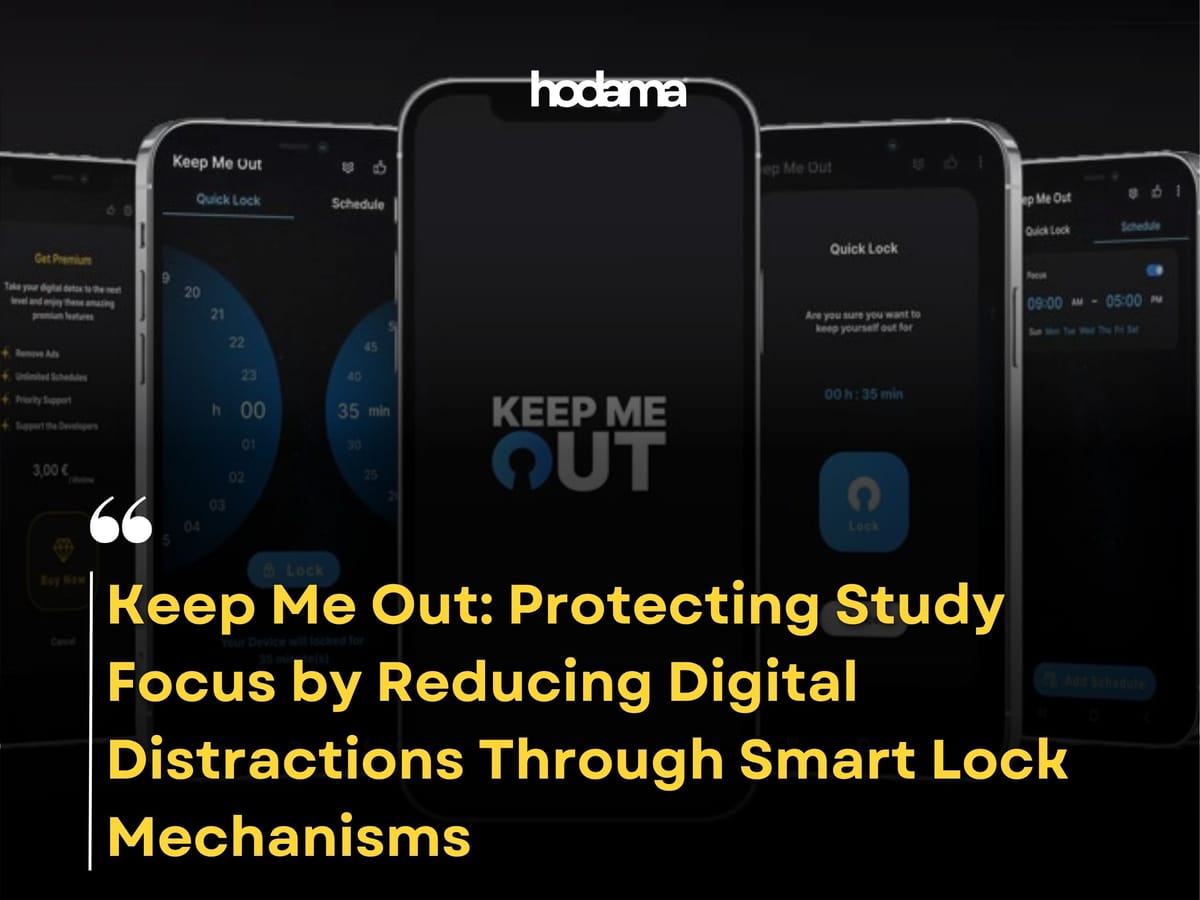
This is exactly the kind of real world problem that apps like Keep Me Out are designed to address. At first glance, the concept seems simple. You set a specific time period during which your phone becomes locked, making it impossible to use most applications. But underneath that simplicity lies a powerful behavioral intervention that goes beyond traditional self discipline.
One of the most important ideas connected to this is attention fragmentation. Research in cognitive science shows that when we switch tasks frequently or get interrupted, our brain does not immediately return to full focus. It takes time to regain depth of concentration, and repeated interruptions reduce both the quality and efficiency of our work. In a world filled with constant digital stimuli, maintaining deep focus has become increasingly difficult, not because people are less capable, but because the environment is designed to compete for their attention.
What makes Keep Me Out particularly effective is that it removes the need to rely purely on willpower. Once activated, the lock cannot be easily overridden. This is where the concept of pre commitment comes into play. Instead of trusting your future self to resist distractions, you make a decision in advance and create a system that enforces it. In behavioral economics, this is seen as a practical way to bridge the gap between intention and action.
There is also an interesting psychological shift that happens when you know you cannot access your phone. The temptation itself weakens. You are no longer negotiating with yourself every few minutes. That mental space becomes available for deeper thinking, learning, and creativity. In that sense, the app does not just block distractions, it reshapes your interaction with them.
Some might argue that using technology to solve problems created by technology is contradictory. But in reality, we already manage our environments to improve focus. We choose quieter places, turn off notifications, or distance ourselves from distractions. What this app does is formalize and automate that process in a more structured and reliable way.
In contexts like modern education, remote work, and self directed learning, especially in places where digital access is constantly increasing, tools like Keep Me Out can play a meaningful role. They are not a replacement for discipline, but they act as a support system that makes discipline easier to maintain.
Ultimately, focus is not something people either have or do not have. It is something that is shaped by systems, habits, and environments. If distractions are engineered to capture our attention, then it makes sense to intentionally design systems that protect it. Technology can easily become a source of distraction, but when used thoughtfully, it can also become a powerful ally in helping us do the work that truly matters.