
Wake Me There: A Smarter Location Based Alarm Transforming Everyday Commute Experiences

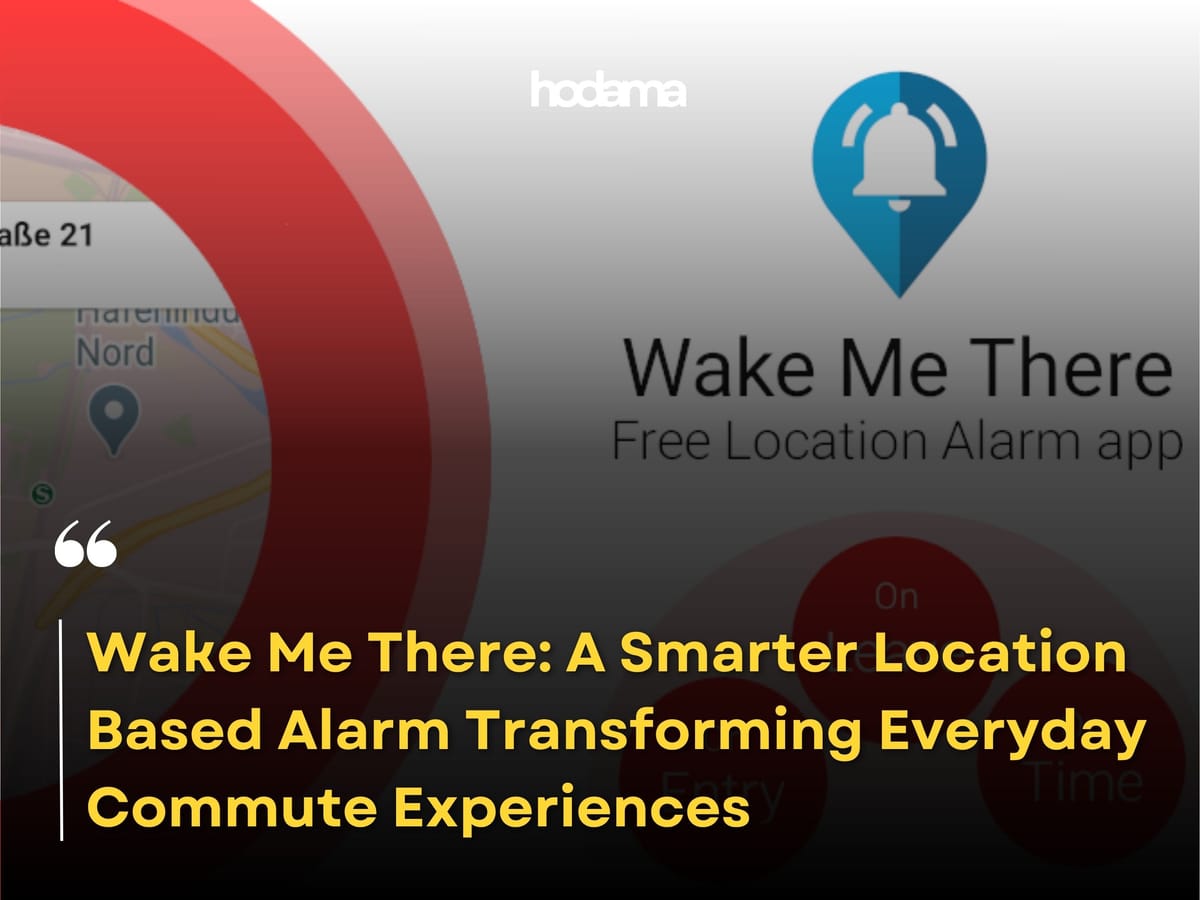
There is a very familiar moment most of us have experienced at least once. You get onto a bus or a train after a long day, tell yourself you will just rest your eyes for a minute, and the next thing you know you wake up far beyond your stop. It sounds trivial, but for daily commuters this small inconvenience quietly adds stress, wasted time, and sometimes even anxiety. What makes “Wake Me There” interesting is not just that it solves this problem, but how it rethinks the relationship between human behavior and mobile technology.
At its core, Wake Me There is built around GPS tracking and geofencing, two concepts that have existed for years but are now being used more intelligently in consumer applications. While GPS provides continuous location data, geofencing allows developers to define a virtual boundary around a real world location. When a user enters that predefined zone, a trigger is activated. In this case, that trigger becomes an alarm that wakes you up just before you reach your destination. It sounds simple, but the shift from time based logic to location aware intelligence is what makes the experience fundamentally different.
Traditional alarm systems rely on time. You set an alarm for a specific hour and expect the world to behave predictably around it. But real world travel does not follow predictable patterns. Traffic congestion, delays, route diversions, and unexpected stops constantly disrupt timing. This is where Wake Me There introduces a more adaptive model. Instead of forcing the user to calculate when they might arrive, the app responds dynamically to where they actually are. This reflects a broader trend in mobile computing where systems are becoming context aware rather than rule based.
Looking at global usage patterns, location based services have seen significant growth, especially in densely populated urban environments. As more people rely on public transport and spend long hours commuting, small efficiency tools like this become surprisingly impactful. There is also a psychological dimension to this. When users know they can safely fall asleep without missing their stop, it reduces cognitive load. Instead of constantly staying alert, they can relax, making commuting feel less exhausting.
Another important aspect that often goes unnoticed is how such apps manage background processing and battery consumption. Continuous GPS tracking can drain power quickly, which is a major limitation for real world usage. Modern implementations solve this through adaptive tracking techniques, such as switching between high accuracy and low power modes depending on movement patterns. This balance between performance and efficiency is what determines whether an app remains practical beyond its initial novelty.
From a broader perspective, Wake Me There represents a category of applications that do not try to overwhelm users with complexity. It does not rely on advanced artificial intelligence or heavy data modeling. Instead, it takes existing technologies and applies them thoughtfully to a real everyday problem. This kind of focused innovation is often more valuable than large scale disruptive systems because it directly improves daily life in small but meaningful ways.
There is also an accessibility angle worth considering. For students, shift workers, and long distance commuters, the ability to convert travel time into rest without risk changes how they manage their energy throughout the day. It subtly transforms commuting from a passive necessity into a controlled, even restorative experience. In that sense, the app is not just about waking someone up. It is about giving them confidence in how they use their time.
What this ultimately highlights is a shift in how we expect technology to behave. Instead of users adapting to rigid systems, we now expect systems to adapt to human habits. Wake Me There fits neatly into this evolution. It demonstrates that innovation does not always require something entirely new. Sometimes, it is about connecting existing capabilities in a way that feels intuitive and human centered.
And perhaps that is the most interesting takeaway. The idea that you can fall asleep during your commute without worrying about missing your stop is no longer a careless risk. It is a designed experience. A small change, but one that quietly improves everyday life.